-01.png)
Indonesia's Carbon Market Enters a New Era: Inside the SRUK Launch
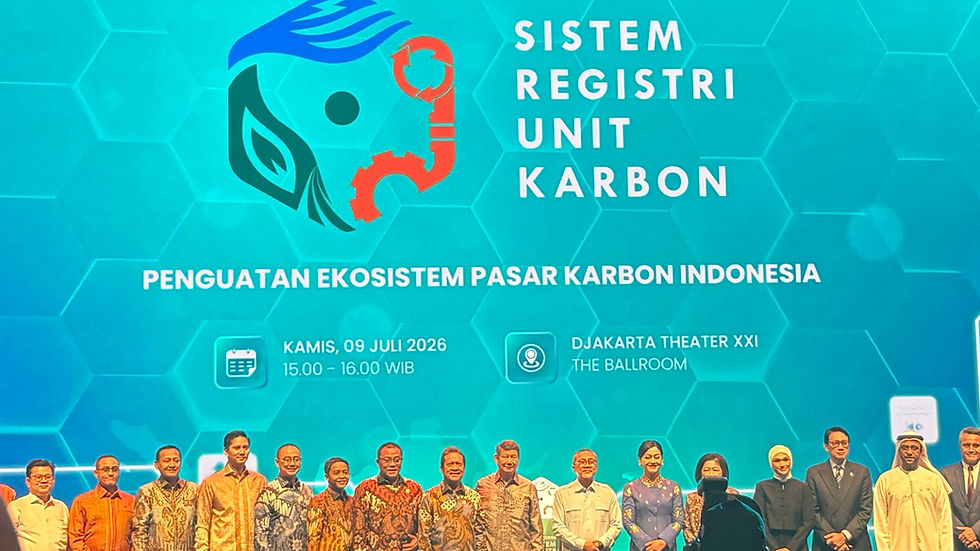
Yesterday, I attended the grand launch of Indonesia's new carbon trading registry system — what we call SRUK — marking the start of a new era for Indonesia's carbon market. Ministers and heads of related agencies gave their remarks, and there was plenty of stakeholder mingling and catching up.
Let's unpack it.
What is SRUK?

With the issuance of the new Minister of Environment Regulation (Permen LH) No. 10/2026 — the implementing regulation mandated by Article 59 of Presidential Regulation (Perpres) No. 110/2025 — the government has specifically regulated the operation of the Carbon Unit Registry System (Sistem Registri Unit Karbon, or SRUK). The regulation defines SRUK as a platform for providing and managing data and information related to the ownership and movement of Carbon Units within the implementation of Indonesia's Carbon Economic Value (Nilai Ekonomi Karbon, or NEK) framework.
In simple terms: it's the platform where every carbon unit generated in Indonesia is recorded, and every transfer of ownership must be logged on this system.
Why does it matter?
The system's main purpose is to support Indonesia's NDC target while also serving as the primary safeguard against double counting. Through SRUK, the government tracks the entire lifecycle of a carbon unit — from the issuance of Emission Reduction Certificates (SPE GRK) and Non-SPE GRK units, through trading transactions, to their eventual use (such as emission offsetting or retirement) — transparently and permanently.
How does it interact with other registries?
SRUK is designed to be interoperable with other registries, including:
Interaction with SRN PPI — The two systems have a clear division of labor. If SRN PPI (the National Registry System for Climate Change Control) is the platform that records Mitigation and Adaptation Actions, then SRUK is the "digital wallet" that records the Carbon Units generated from those actions. The two are closely linked: recording a Corresponding Adjustment for a carbon unit exported through SRUK will automatically update the GHG emissions accounting in Indonesia's NDC report within SRN PPI.
Interaction with the Carbon Exchange (IDXCarbon) — The Carbon Exchange is legally required to provide an API or integrated data communication protocol connected directly to SRUK. Every time a trade occurs on the exchange, data such as new ownership and changes in a carbon unit's status (e.g., becoming available, retired, or cancelled) is synchronized to SRUK in real time.
Interaction with international registries — SRUK uses international data model standards, allowing it to connect, exchange data, and carry out verification with global/foreign carbon registry schemes.
The Indonesian government also operates other systems, such as APPLE Gatrik for power plants and the Sistem Informasi Industri Nasional (SIINas) for the industrial sector, alongside a separate GHG inventory recording system — it remains to be seen how this platform will connect with the others.
OJK moves in tandem: POJK 10/2026

The registry launch did not happen in isolation. Just days earlier, on 6 July 2026, the Financial Services Authority (OJK) issued POJK No. 10/2026, amending the rules governing carbon trading through the Carbon Exchange — a direct follow-up to Perpres 110/2025. Four changes are worth flagging for corporates and state-owned enterprises (SOEs) with exposure to the carbon market:
SRUK as the single reference point — trading on the Carbon Exchange must now formally refer to SRUK, replacing the previous reliance on SRN PPI.
Expanded scope of tradable units — the regulation broadens the types of carbon units that may be traded, and, under certain conditions, permits trading of foreign carbon units not yet recorded in SRUK.
New reporting obligations — Carbon Exchange operators must now submit specific reports to the relevant ministries, strengthening transparency and accountability across every transaction.
Financial-sector consumer protection — standard consumer protection principles applicable to the financial services sector now extend to all parties involved in carbon trading.
A transition period of up to three months applies before all trading activity must fully comply with the new SRUK-referenced regime. For SOEs such as PLN, Pertamina, and the Perhutani/PTPN group — all significant potential participants as both regulated emitters and carbon project developers — this is a timeline worth building into internal compliance planning now.
Carbon units as an asset class

Even though trading volume on IDXCarbon remains low, its existence at least confirms that the foundational infrastructure is now in place. With the system ready and complete, it will be worth watching how market participants respond. Based on recent discussions at Climate Future APAC and the Indonesia Sustainability Forum last month, one signal came through clearly: carbon units are increasingly being treated as an asset class in their own right.
The conversation is no longer just about how to develop a carbon project. Market participants are now discussing bankability, long-term offtake agreements, carbon insurance, and financing structures — the same considerations that apply to any typical infrastructure project.
From a legal perspective, Indonesia already recognizes carbon units as efek (securities), but this classification is now taking clearer shape. The next question is: can they be pledged as collateral? What about derivatives? And is a sharia label needed?
A word of caution
One important message from the Ministry of Environment, echoed by Pak Hashim Djojohadikusumo, the President's Special Envoy for Climate and Energy, is that the benefits of the carbon economy must reach the ground — the local communities in project areas.

Separately, I had the opportunity, as a representative of ACEXI, to deliver training at KPK on the potential for fraud in carbon trading activities. Many such cases have already occurred around the world, but awareness of these risks remains far too limited in Indonesia. Overclaiming, money laundering, elite capture, and unfair benefit distribution are real risks on the ground.
Closing thoughts
Taken together, the SRUK launch — paired with OJK's POJK 10/2026 — is more than a technical milestone. It signals that Indonesia's carbon market is entering its next phase of maturity, with clearer registry infrastructure, tighter exchange oversight, and growing institutional appetite. But infrastructure alone won't guarantee integrity. As carbon units increasingly behave like financial assets, the real test will be whether the benefits — and the safeguards — actually reach the communities and ecosystems these projects are meant to protect.
For readers tracking the forestry side of this transition specifically, do have a look at my colleagues' client update at Soemadipradja & Taher (S&T) on the new forestry carbon trading framework: soemadipradjataher.com/news-insights/new-forestry-carbon-trading-framework.


-02.png)
Really interesting to see Indonesia taking a more structured approach to carbon markets and making the tracking process more transparent. On a lighter note, when I get some free time after reading about topics like this, I like unwinding with Subway Surfers Online —it’s a simple, fun way to relax for a few minutes.